Do you know what black-grass is costing your farm business?
Business Development Manager, Stuart Kevis, discusses the hidden costs of grassweeds and a how a new calculator will help put a figure on them.
Counting the Cost of Black-grass
The cost of black-grass is hidden within every arable farm’s accounts. It won’t have its own line, but it is there; an almost invisible force that drives crop choices and drilling dates, stealing yield. New this season, BASF have developed a costing model to demonstrate the true cost as well as a calculator, so you can assess your own pressure and impact.
The Hidden Equation: Yield vs Herbicide Spend
“When tight margins force tough calls, it is easy to focus on immediate input costs,” says Stuart Kevis, Business Development Manager at BASF.
“The reality is more complex. Even low populations of black-grass, if poorly controlled, robs valuable yield and creates seed banks that complicate cropping for years to come.”
Modelling the True Opportunity Cost
To get a better understanding of the effects of black-grass, BASF created a model which plots the cost of herbicide programmes, the resulting percentage control and the yield loss associated with the survivors.
The image below shows the true cost of black-grass control, combining herbicide spend and the cost of yield losses, with model parameters set to a scenario of £170/t grain price, 9t/ha yield, and a black-grass population of 50 plants/m2.
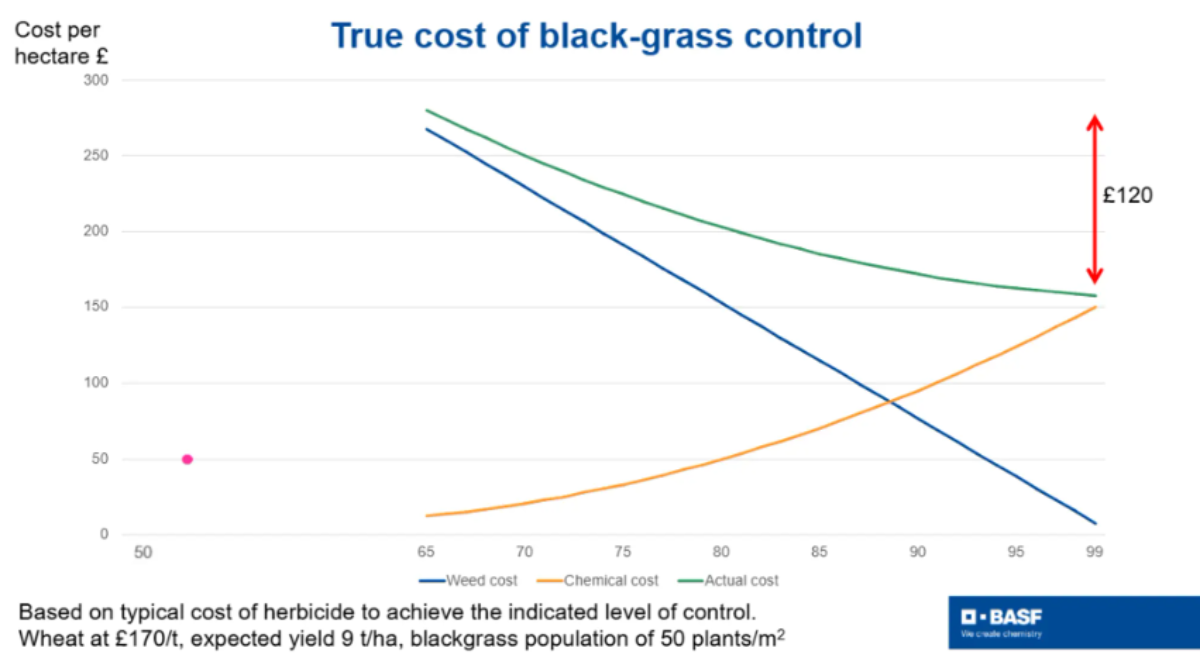
- Low spend, high cost
“A herbicide programme of generic flufenacet and diflufenican, is likely to give you roughly 65% control. Although that probably costs just £12/ha, there’s a hidden £270/ha in lost yield. The total financial impact to the farm is around £280/ha,” he explains.
- High spend, low cost
“At the other extreme - 99% control - you’ll lose barely any yield, around £10/ha, but the herbicide programme is likely to be costly around £150/ha. However, at £160/ha that is still significantly less than the total cost associated with the very cheap programme, due to the preservation of yield. In fact, you’re £120 better off.”
This model doesn’t show seed return which has ramifications for the years to come – and that was the reason for the development of the Grassweed Calculator.
Luximo: The Cornerstone of Herbicide Programmes
Taking the learnings from the model and the calculator, Stuart strongly recommends growers invest in robust herbicide programmes this year, starting with Luximo.
“Luximo, with its unique mode of action and proven performance, is the most effective residual herbicide and should be the cornerstone of any programme aimed at black-grass and ryegrass,” he says.
Across 97 UK pre-emergence black-grass trials across six years, Luximo® plus pendimethalin and diflufenican outperformed Liberator (flufenacet + diflufenican) + aclonifen by an average of 12.5 percentage points in control.
“Even where pressure is low, Luximo offers a valuable return on investment by protecting yield,” says Stuart.
Use the Grassweed Cost Calculator
This season, BASF is enabling growers to put a more accurate figure on the cost of black-grass through its Grassweed Cost Calculator.
It is simple to use. Just enter your anticipated wheat yield, herbicide programme spend and black-grass pressure, and the calculator will reveal the impact of your grassweeds - combining lost yield, crop protection cost, and future seed return - so your decisions are driven by data.
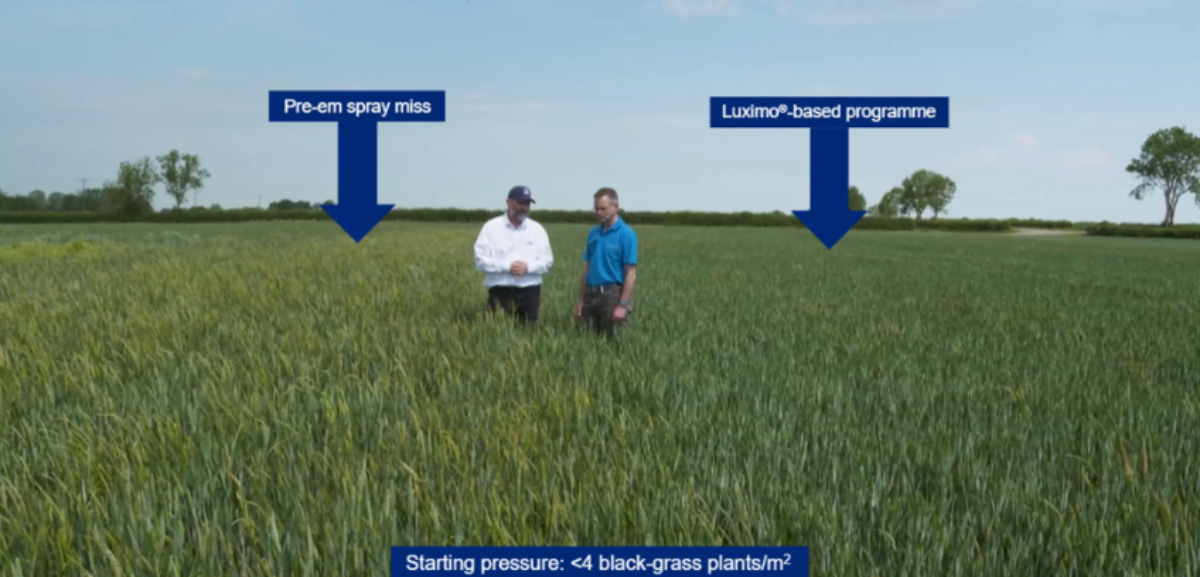
In Cambridgeshire, John Cussans (ADAS) & Stuart Kevis (BASF) explore the impact of a spray miss in a commercial crop. Having shown less than 4 plants/m2 the previous year, the high number of weeds this year provides a strong example for why maintaining high levels of control is critical.